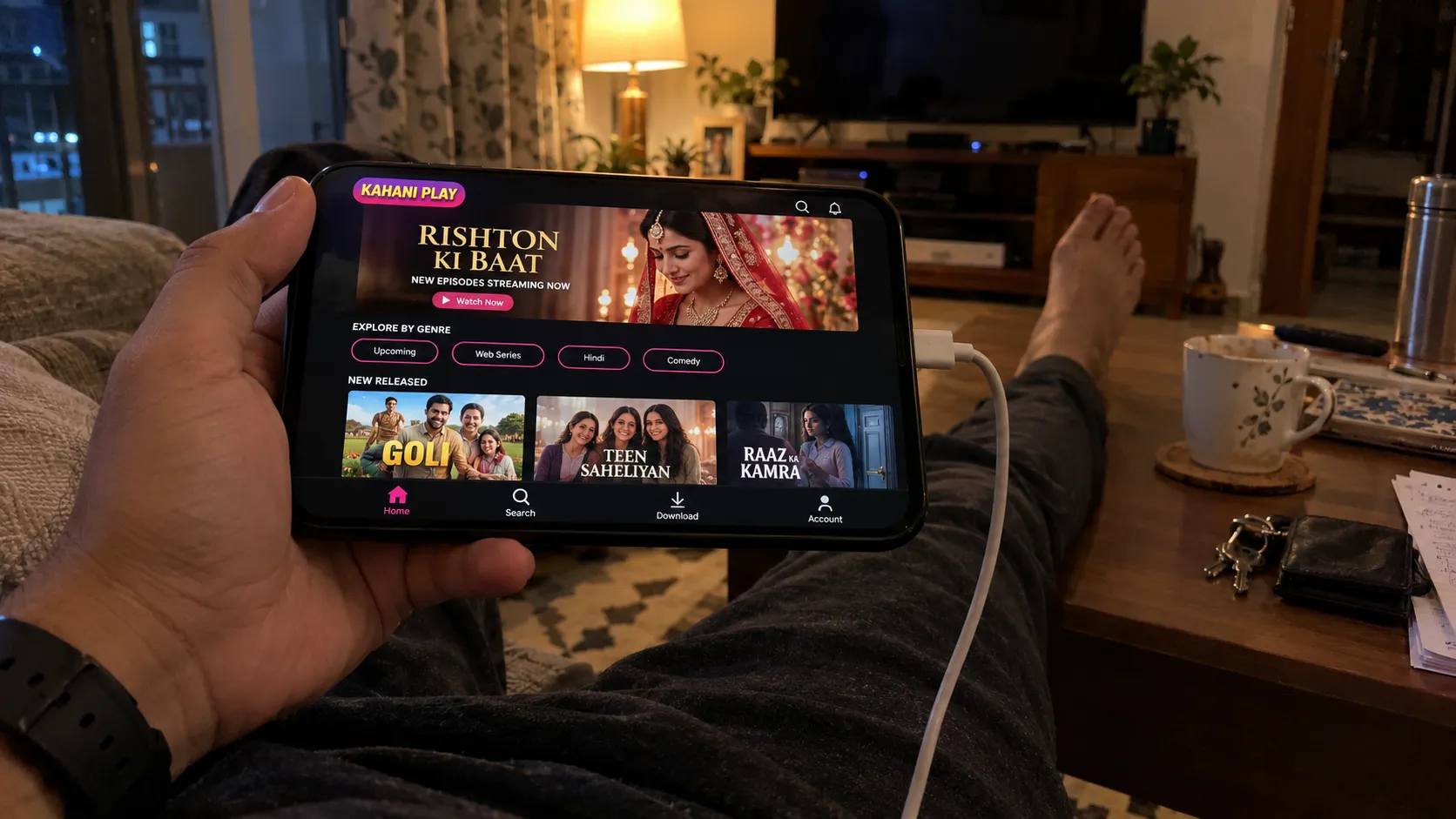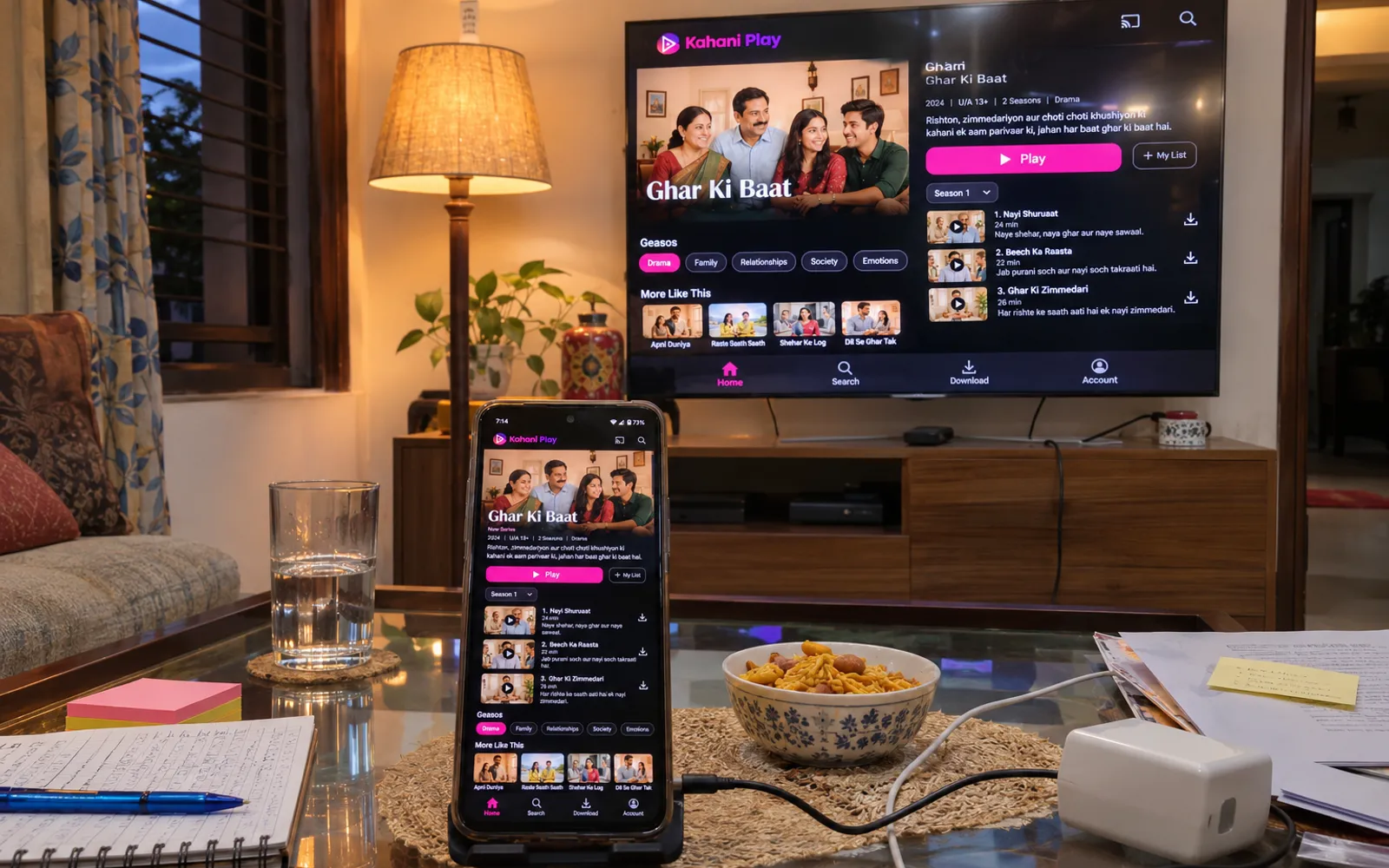
Founders who want to build a streaming app usually ask me two questions: what will the app cost, and what will it cost to keep running once people start watching. The second number matters more than most people expect. With a normal app, servers are a small line item. With an OTT app, video bandwidth can overtake the build cost within a year if the app takes off.
I built and still maintain Kahani Play, a Flutter streaming app with more than 500,000 downloads on Google Play, so the numbers below come from doing this work, not from a pricing page. For general app pricing in India, start with my app development cost guide. This one only covers streaming.
OTT app cost in India: MVP vs full platform
Streaming sits in the complex bucket of app development. Even a small OTT app is several products: the mobile app, a video pipeline that prepares your files for streaming, a backend that knows who has paid for what, and an admin panel your team uses to publish content. The ranges below assume Android and iOS from one Flutter codebase, with design included.
| Tier | What you get | Typical cost (INR) | Typical cost (USD) | Timeline |
|---|---|---|---|---|
| MVP | Android + iOS app, catalogue, HLS playback, phone OTP login, one subscription plan with UPI and in-app purchase, basic admin panel | ₹8 lakh – ₹14 lakh | $9,600 – $17,000 | 3–5 months |
| Full platform | Everything above plus encrypted offline downloads, DRM, multiple plans and coupons, series and seasons, analytics, a proper CMS | ₹15 lakh – ₹30 lakh | $18,000 – $36,000 | 5–9 months |
| Platform with TV and live | Full platform plus Android TV or Fire TV apps, Apple TV, live streaming, several languages | ₹30 lakh+ | $36,000+ | 9 months+ |
Cheaper options exist. White-label OTT products will give you a branded app for a monthly fee, and clone scripts are sold for less than a decent laptop. They're fine for testing whether anyone will pay for your content. They get painful the moment you want your own payment flow, a different home screen or a format the vendor doesn't support, and you never own the code.
Feature-by-feature cost of a streaming app
When I price a streaming project, I break it down roughly like this. The ranges are for an experienced freelancer or small studio and include backend work for each feature.
| Feature | What it involves | Typical cost (INR) | Typical cost (USD) |
|---|---|---|---|
| Video pipeline | Upload, HLS transcoding into several qualities, thumbnails, storage and CDN setup | ₹1.5 – ₹4 lakh | $1,800 – $4,800 |
| Video player | Adaptive HLS, quality picker, resume where you left off, subtitles, skip intro, picture-in-picture | ₹80,000 – ₹2 lakh | $950 – $2,400 |
| DRM | Widevine on Android, FairPlay on iPhone through a multi-DRM provider, licence server integration | ₹1.5 – ₹4 lakh | $1,800 – $4,800 |
| Offline downloads | Encrypted files in app-private storage, background downloads, expiry, storage management | ₹1.5 – ₹3.5 lakh | $1,800 – $4,200 |
| Subscriptions and payments | Razorpay or Cashfree with UPI and cards, UPI autopay, Apple and Google in-app purchase, one entitlement system across both | ₹1.5 – ₹4 lakh | $1,800 – $4,800 |
| Catalogue and accounts | Home rows, genres, series and seasons, search, watch history, wishlist, OTP login, profiles | ₹1.5 – ₹3 lakh | $1,800 – $3,600 |
| Admin CMS | Upload and publish content, schedule releases, manage plans, users, coupons and banners | ₹1.5 – ₹4 lakh | $1,800 – $4,800 |
| Analytics | Watch time, completion, drop-off points, conversion from free to paid, crash reporting | ₹50,000 – ₹1.5 lakh | $600 – $1,800 |
| TV apps | Android TV or Fire TV with remote control support; Apple TV is a separate build | ₹3 – ₹8 lakh per platform | $3,600 – $9,600 per platform |
Two lines on that table surprise people. The first is payments. On Android you can take UPI through a gateway, but on iPhone, digital subscriptions have to go through Apple's in-app purchase. So you end up with two or three payment systems that all need to grant access to the same content, and the backend has to agree with every one of them. I've written up how I handle the Android side in Razorpay subscriptions in Flutter.
The second is offline downloads. A download button looks like one feature. In practice it's encryption, background download handling on Android, storage limits, expiry when a subscription lapses and a lot of testing on low-end phones. My notes on offline video downloads in Flutter go through the details.
Do you need DRM on day one?
Not always. DRM stops casual copying of your streams, and studios licensing content to you will often require it in the contract. If you own all your content and you're still testing demand, encrypted HLS with signed URLs and encrypted downloads covers most of the risk for a fraction of the cost. Add full DRM when a licence deal asks for it or piracy is actually hurting you. Retrofitting it later is a few weeks of work, not a rebuild, if the pipeline was designed sensibly.
Ongoing costs: what a streaming app costs to run
This is the section to read twice. Every running cost below grows with your audience or your library, and the biggest one grows with every minute people watch.
- CDN bandwidth. You pay for every gigabyte delivered to viewers. Mainstream CDNs in India typically charge a few rupees per GB, dropping at higher volumes. This scales with total watch hours, not with users, so a small audience of heavy viewers can cost more than a large audience of casual ones.
- Video storage. Each title is stored in several qualities, so an hour of content can take a few GB once transcoded. A library of a thousand hours usually costs a few thousand rupees a month to store. It grows with your library, slowly.
- Transcoding. Managed services charge per minute of video processed, per quality. It's a one-off cost each time you upload, so it scales with how much content you publish, not how much people watch.
- DRM licences. Multi-DRM providers charge per licence issued or a monthly minimum, whichever is higher. Check current pricing before you commit, because the minimum can be significant for a small app.
- Store fees. Apple charges $99 a year and Google Play a one-time $25. If you sell subscriptions through in-app purchase, Apple and Google take 15 to 30 percent of those sales.
- Payment gateway fees. Gateways typically take around 2 percent per transaction, with different rates for UPI, cards and recurring payments. Check your plan, because the rates change.
- Servers, SMS and maintenance. The backend, database, OTP messages and push notifications, plus the usual 15 to 20 percent of build cost per year for app maintenance.
A quick bandwidth estimate
Here's the sum I walk every client through. Say 10,000 people watch 10 hours a month each, mostly at around 480p to 720p on phones, which is roughly 0.5 to 1 GB per hour. That's 100,000 hours and somewhere between 50 and 100 TB of bandwidth a month. At a few rupees per GB, you're looking at lakhs per month, not thousands. Double the viewers and the bill doubles.
Default quality is a cost decision. Starting phones on a sensible quality and letting adaptive streaming step up only when the connection allows can cut your bandwidth bill a lot, and most viewers on a 6-inch screen won't notice.
How long it takes to build an OTT app
A focused MVP takes 3 to 5 months with one experienced developer or a small team. A full platform with downloads, DRM, several payment methods and a proper CMS is more like 5 to 9 months. TV apps add a couple of months each. App Store review for a subscription app can also add a week or two, because Apple looks hard at how you sell digital content. There's more on what drives these numbers in how long it takes to build an app.
Ways to cut the cost
- Launch on Android first. For most Indian streaming audiences that's where the users are. With Flutter, iPhone comes later as mostly testing, App Store work and in-app purchase.
- Rent the video pipeline. A managed video service handles upload, transcoding and delivery for a usage fee. Building your own transcoding servers only makes sense at serious scale.
- Skip TV apps for version one. Most viewers in India watch on phones. Add a TV app when your analytics show people asking for it.
- Start with encrypted HLS, add DRM when a contract needs it. See the section above.
- One subscription plan to begin with. Every extra plan, trial and coupon type multiplies testing across gateways and stores.
- Scope an MVP properly. My guide on MVP app development covers how to pick the one flow that proves people will pay.
Lessons from building Kahani Play
Kahani Play is an Indian streaming app for movies, web series and short clips. I've shipped more than 70 releases of it. A few things I'd tell anyone pricing a similar app:
- Design for cheap phones and patchy data. Adaptive HLS that picks quality for the phone and the connection made the biggest difference to how fast video starts. Tuning playback and start-up time with real data after launch mattered as much as the first build.
- Offline viewing is worth it in India. People download on Wi-Fi and watch later. Kahani Play's downloads are encrypted and kept in app-private storage, with a native Android layer for background downloads. That native layer was real extra work, and it's the kind of thing a cheap quote leaves out.
- Payments are a project of their own. Kahani Play takes UPI and Google Pay, SabPaisa and Cashfree on Android, and Apple in-app purchase on iPhone. Each one needed its own testing and its own edge cases.
- Give the content team their own tools. A Next.js admin panel lets the team upload and publish without calling a developer. If your editors depend on you for every release, the app slows down.
- The app keeps changing after launch. Short clips, new payment options, the iPhone build and a rebuilt backend and admin panel all came after the first release. Budget for that from day one.
What I'd charge, and how to get a real number
I build streaming apps with Flutter app development for both platforms and a NestJS backend through my backend development work, and I usually start clients with a scoped first version through MVP development. You get a fixed-scope proposal in INR with one price and a timeline, and a test build on your phone most weeks.
If you're building something in learning rather than entertainment, my guide to edtech app development cost in India covers video lessons, tests and parent apps. For a rough figure on your own idea, try the app cost calculator, read how I work with clients on hiring an app developer in India, or tell me about your streaming app.