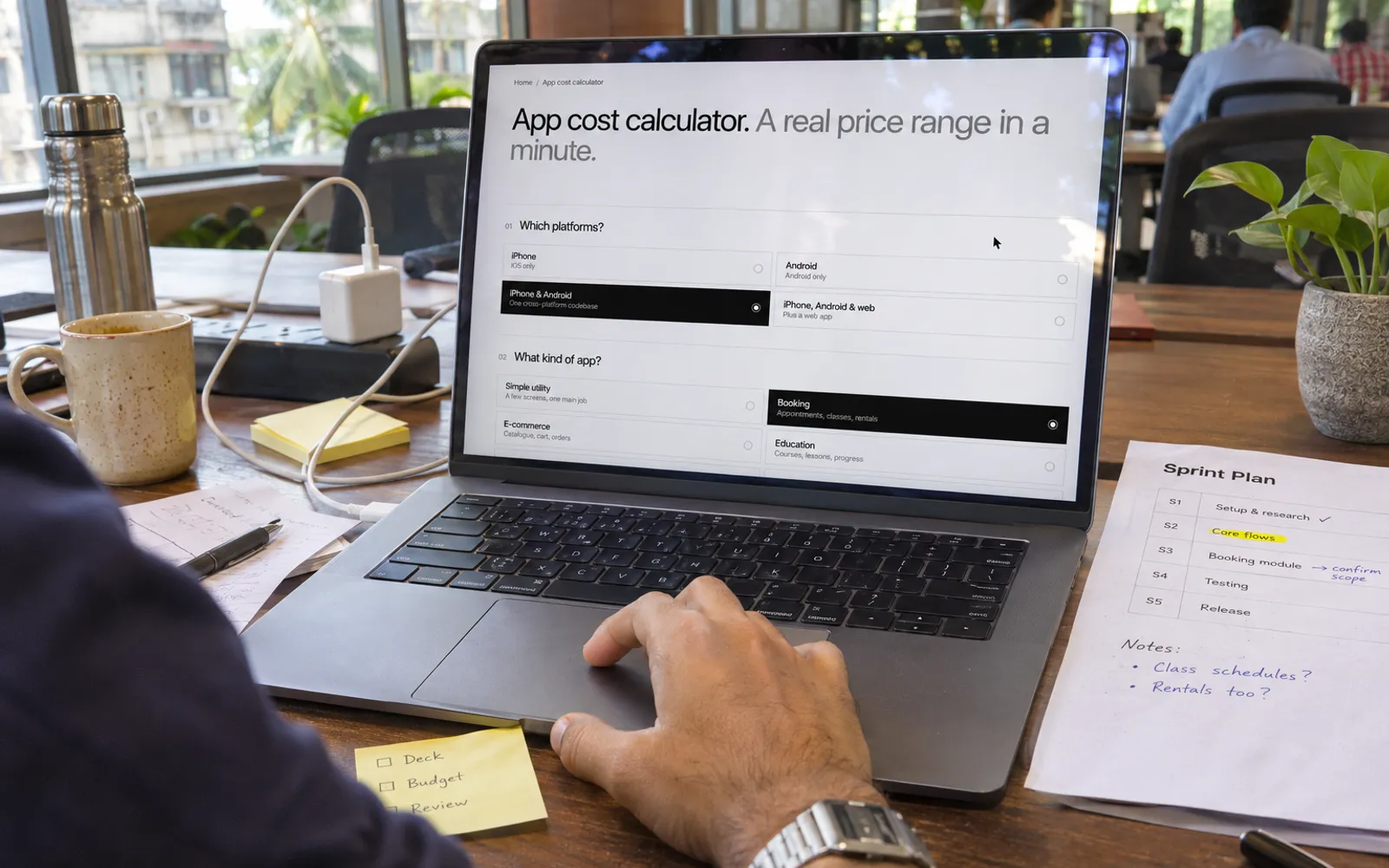
Founders usually ask me for one number. A SaaS product doesn't have one, because the same idea can be a six-week MVP or a nine-month platform depending on what goes into it. What I can give you is the range for each stage and the price of each feature, so you can build your own estimate before you talk to anyone.
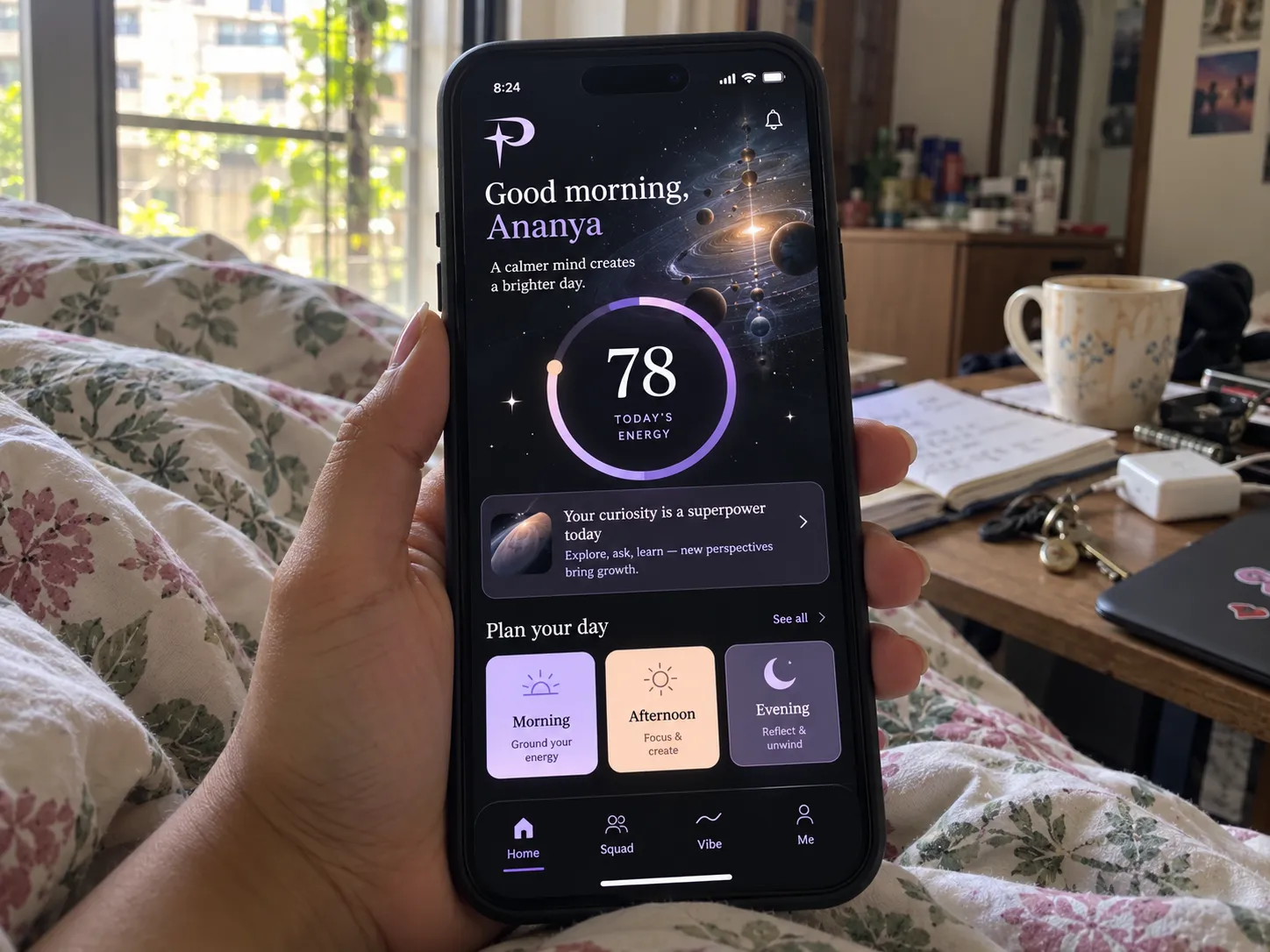
I'm an independent full-stack developer in Mumbai. I build web apps, backends and mobile apps for founders in India, the US and the UK. The backend behind Pulse runs on FastAPI, PostgreSQL and Redis, and its first MVP shipped in 10 weeks from an empty repo. The numbers below are typical market ranges I see, not quotes.
SaaS cost by stage: MVP, v1 and scale
Most SaaS products go through three stages. Each one has a different job, and the budget should follow the job rather than the feature wish list.
| Stage | What it has to prove | International clients (USD) | Indian clients (INR) | Typical timeline |
|---|---|---|---|---|
| MVP | People will sign up, use the core feature and pay | $8,000 – $25,000 | ₹1.5 – 4 lakh | 6–10 weeks |
| Version 1 | Teams can run real work on it every day | $25,000 – $60,000 | ₹4 – 10 lakh | 3–5 months |
| Scale | It holds up with many customers, larger accounts and enterprise asks | $60,000+ spread over months | ₹10 lakh+ | Ongoing |
These sit in line with the app ranges in my MVP app development guide. A web-only SaaS often costs a little less than a mobile app of the same scope, because there is no App Store review, no two platforms and fewer device quirks to test.
US and UK agencies typically quote $10,000 to $40,000 for a simple first version and far more for a full product. I compare those agency prices with offshore and independent options in app development cost in the USA and UK.
What each SaaS feature costs
This is the table I'd use to sanity-check any quote. Each line is the typical extra cost of that feature on a standard Next.js and Postgres build, done properly with tests and an admin view.
| Feature | Simple version | Full version | USD (typical) | INR (typical) |
|---|---|---|---|---|
| Auth, teams and roles | Email or Google sign-in, one user per account | Invites, teams, owner/admin/member roles, SSO later | $800 – $4,000 | ₹30,000 – ₹1.5 lakh |
| Billing (Stripe or Razorpay) | One plan, monthly card subscription | Tiers, seats, trials, coupons, invoices with GST or VAT | $1,000 – $5,000 | ₹40,000 – ₹2 lakh |
| Dashboards | A few counts and one chart | Filters, date ranges, exports, saved views | $1,000 – $6,000 | ₹40,000 – ₹2.5 lakh |
| Admin panel | View users, change plans, issue refunds | Impersonation, audit log, support tools | $1,000 – $4,000 | ₹40,000 – ₹1.5 lakh |
| Multi-tenancy | Every row tagged with an account id | Per-tenant settings, custom domains, data isolation checks | $1,000 – $6,000 | ₹40,000 – ₹2.5 lakh |
| Integrations and webhooks | One integration, outgoing webhooks | Several third-party APIs, retries, a public API with keys | $1,000 – $3,000 each | ₹40,000 – ₹1.2 lakh each |
| Transactional email | Sign-up, reset password, receipts | Digests, notification preferences, branded templates | $300 – $1,500 | ₹15,000 – ₹60,000 |
| File uploads | Images or PDFs to cloud storage | Large files, previews, virus scanning, quotas | $500 – $3,000 | ₹20,000 – ₹1.2 lakh |
| AI features | Summaries or writing help | An assistant that knows the customer's data | $800 – $10,000 | ₹65,000 – ₹8 lakh |
| Product analytics | PostHog or similar, key events tracked | Funnels, cohorts, in-app usage limits by plan | $300 – $2,000 | ₹15,000 – ₹80,000 |
AI is the line with the widest range, and it is also the only one with a running bill that grows with every request. I've broken it down separately in AI app development cost.
Billing deserves more respect than it gets. Stripe suits US and UK customers, and Razorpay is the usual pick for Indian customers who expect UPI and Indian cards. Selling to both often means running both, with webhooks keeping each account's plan in sync. Failed payments, upgrades halfway through a month and tax on invoices are where the time goes.
The stack I'd pick, and why
A SaaS stack should be boring, well documented and easy to hire for later. This is what I reach for on most projects:
- Frontend: Next.js with React. One framework for the marketing site, the logged-in app and server-side pages that rank in Google. Any React developer you hire later can work on it.
- Backend: Node.js with NestJS, or Python with FastAPI. NestJS when the team is JavaScript end to end. FastAPI when the product leans on data work, scheduled jobs or AI, since most of those libraries live in Python.
- Database: PostgreSQL. Relational data, solid transactions and room for search and JSON fields. Almost every SaaS I've seen fits Postgres for years.
- Cache and queues: Redis. Sessions, rate limits and background jobs like sending emails or generating reports.
- Hosting: Vercel or similar for the frontend, a managed platform for the API and database. You pay a little more than renting a raw server, and in return nobody gets woken at 3am to patch it.
Pulse runs on exactly this kind of backend: FastAPI with PostgreSQL, Redis and Celery for the daily jobs. If you want the server side built or reviewed, that is what my backend development work covers.
Monthly running costs and how they grow
The build is a one-off bill. Hosting, email, error tracking and maintenance arrive every month. These are typical ranges, and they move with usage more than with the number of sign-ups.
| Stage | Hosting, database, email, monitoring | What drives it up |
|---|---|---|
| Pre-launch and beta | $0 – $50 (free tiers cover a lot) | Very little |
| First paying customers | $50 – $300 | A paid database plan, backups, a second environment for testing |
| Hundreds of active accounts | $300 – $1,500 | Bigger database, background workers, more email volume |
| Larger customers | $1,500+ | Read replicas, file storage, audit and security tooling |
Plan for maintenance as well: about 15 to 20 percent of the build cost each year for library upgrades, security fixes and small changes. Payment providers also take a percentage of every transaction, so check their current pricing page for your country before you set your plan prices.
Put the hosting, domain, Stripe or Razorpay account and code repository in your company's name from day one. Whoever owns those accounts owns the product.
What to cut from version one
Most SaaS MVPs I see are over-scoped in the same places. Each item below is worth building later, once a paying customer asks for it.
- SSO and SAML. Enterprise buyers want it. Your first ten customers don't. Google sign-in and email cover them.
- Several pricing tiers. Launch with one or two plans. You'll learn what to charge from the first conversations, not from a pricing page.
- Custom roles and permissions. Owner and member is enough for a long time.
- A public API. Build the webhooks or one integration your customers actually use first.
- Custom dashboards. Ship one useful screen and a CSV export. People will tell you which chart they miss.
- Dark mode, white-labelling and a mobile app. A responsive web app works on phones from the first release.
Cutting these can take an MVP from the top of its range to the middle. The method I use to decide what stays is in my page on MVP development.
Build it, use no-code, or something in between
No-code tools like Bubble, Softr or Glide are a fair way to test demand. If you can get ten customers to pay for a rough version built in a few weekends, that tells you more than any spec.
The limits show up once the product works. Complex permissions, multi-tenant data, heavy reports and custom integrations get awkward, the monthly platform bill rises with usage, and moving off later usually means a rebuild rather than a migration. Investors and enterprise buyers also ask where the data lives and who owns the code.
My rule of thumb: use no-code to validate, and write code once you know what customers pay for. If the core of your product is a workflow nobody else offers, start with code, because that workflow is the part no-code handles worst.
Freelancer, agency or offshore team
| Option | Typical cost | Good for | Watch out for |
|---|---|---|---|
| US or UK agency | Highest | Big scopes, fixed deadlines, a team of several | Project management layers you pay for |
| Senior independent developer | Medium | MVPs and v1s with one person accountable | One person's capacity, so check availability |
| Offshore agency | Low to medium | Larger teams on a tight budget | Seniors in the sales call, juniors on the code |
| Low-cost freelancer | Lowest | Small, well-defined tasks | Rewrites when the shortcuts catch up |
The rate per hour matters less than the total cost of a working product you own. I compare regional rates in app developer hourly rates, and the vetting steps for hiring in India are in outsourcing app development to India.
If your SaaS needs a marketing site as well, the pricing for that sits in website development cost in India. For US founders, my page for clients in the USA covers time zones, contracts and payments.
Whoever you hire, ask for a written feature list with one price, milestone payments tied to things you can click through, and repository access from week one.
If you'd like a real number for your product, send me the feature list and I'll reply within one working day with a fixed-scope estimate.